Capital
Penn State-led team: black hole merger remnants track maximum entropy rule
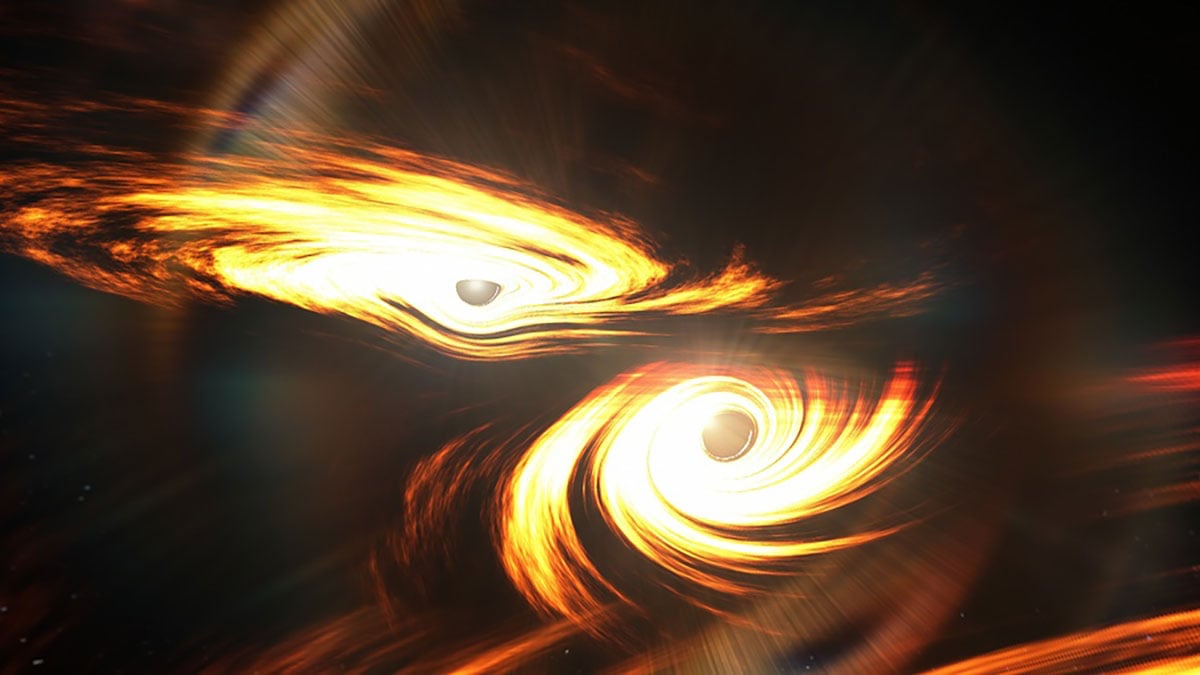 Image: Primary
 Physicists led by Penn State report that a simple thermodynamic rule can closely predict the mass and spin of the black hole left after two orbiting black holes merge, SciTechDaily wrote, summarizing research published in Physical Review Letters and selected as an editor's suggestion.
Mergers usually require supercomputers to solve Einstein's general-relativity equations. First author Monica Rincon-Ramirez and colleagues instead tested a "maximum entropy conjecture for black hole mergers": after gravitational waves carry away energy and angular momentum, the remnant settles near the state with the greatest possible entropy. Comparing that peak with independent numerical-relativity predictions, they found agreement within a few percent.
Co-authors include Nathan K. Johnson-McDaniel of the University of Mississippi, Eugenio Bianchi and Vaishak Prasad of Penn State, Ish Gupta, and B.S. Sathyaprakash, who leads the team at Penn State. The work extends black-hole thermodynamics analogies dating to the 1970s and Stephen Hawking's work on black-hole radiation. SciTechDaily cited the Physical Review Letters paper Maximum Entropy Conjecture for Black Hole Mergers (DOI 10.1103/hvp6-ydbq) and said the U.S. National Science Foundation funded the research.
Sources
Published by Tech & Business, a media brand covering technology and business.
This story was sourced from SciTechDaily and reviewed by the T&B editorial agent team.