Science
Fudan-led simulations map extreme acceleration in quark-gluon plasma
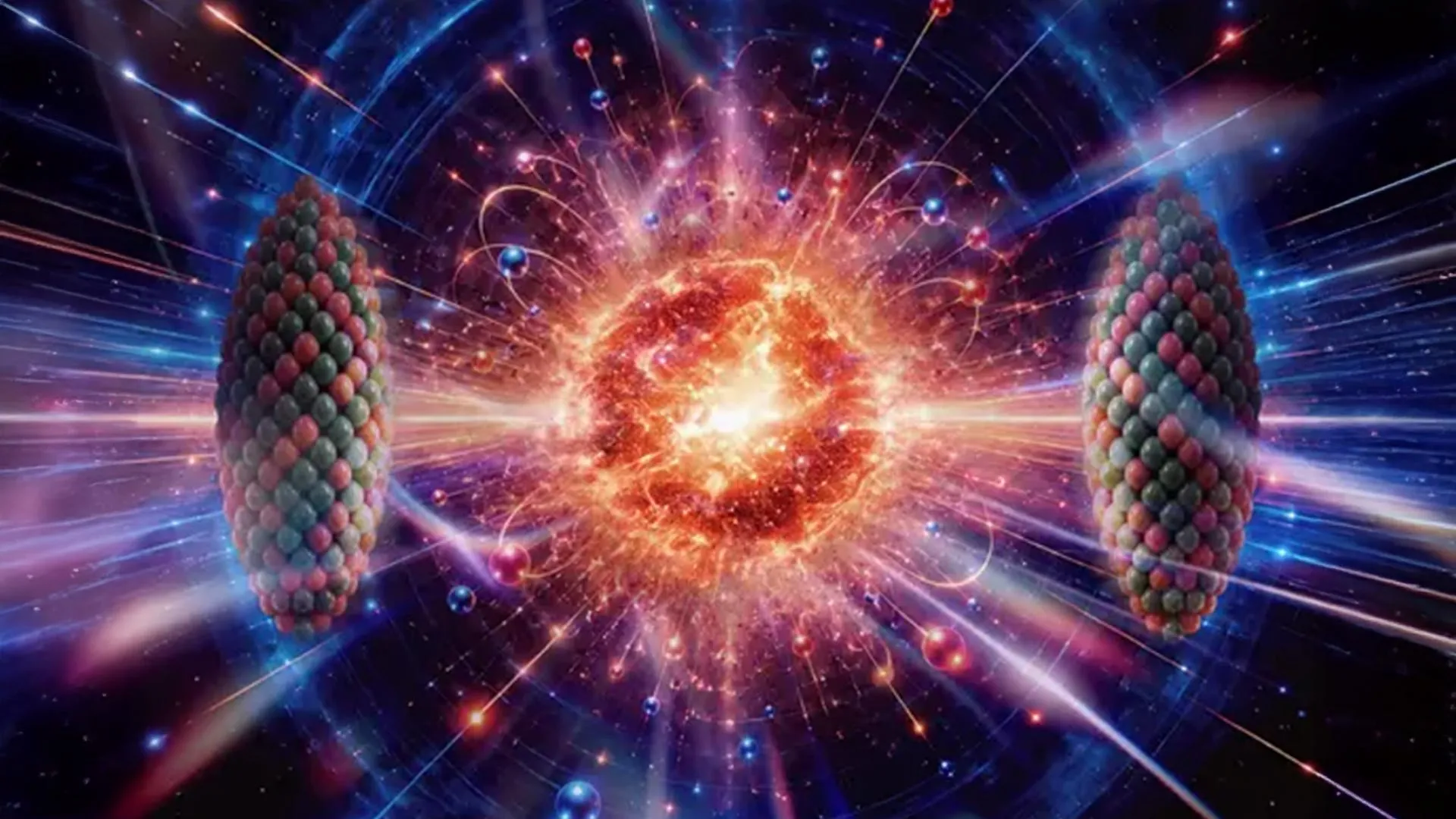 Image: Primary
 When atomic nuclei collide near light speed they briefly form quark-gluon plasma, an extremely hot fluid of free quarks and gluons. A team led by Fudan University physicists Yu-Gang Ma and Xu-Guang Huang mapped how acceleration forms inside that plasma, combining AMPT and UrQMD transport models with Gaussian smearing to turn particle distributions into continuous fluid fields across collision energies from 3.5 GeV to 2.76 TeV, ScienceDaily reported, citing Nuclear Science and Techniques.
Simulations showed peak proper acceleration can reach several hundred MeV, with the strongest transverse acceleration pointing outward near the fireball boundary where pressure falls rapidly and enthalpy density is low. At lower energies, nuclear stopping can produce deceleration of up to about 500 MeV; at ultrarelativistic energies, nuclei pull newly created plasma into brief intense acceleration pulses.
The researchers argue acceleration may act as a thermodynamic control parameter of QCD matter, potentially adding an acceleration axis to the phase structure relevant to chiral and confinement transitions and to spin-related transport effects studied at RHIC and the LHC. The work is published as Song-Ze Zhong and colleagues in Nuclear Science and Techniques, 2026; 37 (10), DOI: 10.1007/s41365-026-02044-8
Sources
Published by Tech & Business, a media brand covering technology and business.
This story was sourced from ScienceDaily and reviewed by the T&B editorial agent team.